How to Tell if Your Content Is Actually Working (Without Being a Data Analyst)
You don't need a dashboard obsession or a statistics degree. Here's a plain-English guide to the metrics that actually matter — and what to do when the numbers don't look right.
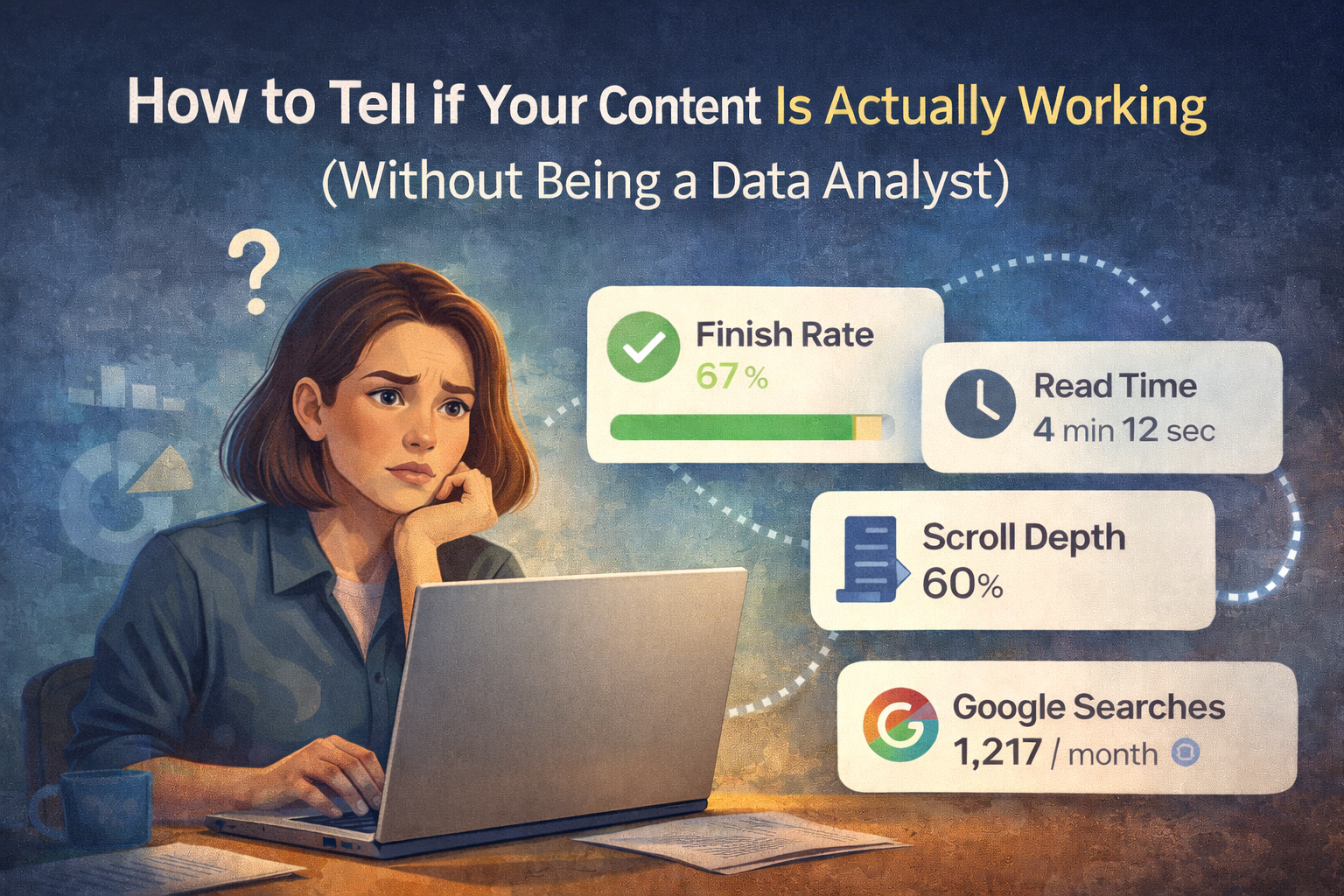
You published something. Maybe it felt good. Maybe it felt like a shot in the dark. Either way, a few days pass and you find yourself opening Google Analytics, staring at a wall of numbers, and closing the tab none the wiser.
Sound familiar? You're not alone. Nearly half of all B2B marketers — people whose job it is to produce content — admit they don't measure the ROI of their content marketing at all. For independent writers, bloggers, and small content teams, that number is almost certainly higher.
The problem isn't that the data doesn't exist. It's that most analytics tools were built for data teams, not writers. They give you numbers without meaning, metrics without context, and dashboards without answers.
This guide cuts through that. You'll learn exactly which signals tell you whether your content is working, what each one actually means in plain English, and what to do when something looks off — no technical background required.
1. Why Measuring Content Matters More Than Ever
Content creation has never been more competitive. There are now over 600 million blogs on the internet, and AI tools have dramatically increased the volume of content being produced every day. In this environment, publishing without measuring isn't just inefficient — it's a strategic disadvantage.
Only 20% of bloggers report strong results from their content. Among those who spend more than six hours per article, the rate of strong results is significantly higher.
47% of B2B marketers don't measure ROI from their content marketing efforts at all.
Those two statistics together tell an important story: most people are investing real time and effort into content, but aren't closing the feedback loop. Without measurement, there's no way to know what's working, what to double down on, or what to quietly retire.
The good news? You don't need to track everything. You need to track the right things. And there are really only a handful of metrics that matter for most writers and content creators.
2. Vanity Metrics vs. Value Metrics: Know the Difference
Before we get into specific numbers, it helps to understand why so many writers feel like they're measuring things without learning anything. The culprit is usually vanity metrics — numbers that look impressive but don't tell you much about whether your content is actually doing its job.
Vanity metrics (interesting, but limited)
- Pageviews — tells you how many times a page loaded, not whether anyone read it
- Social media impressions — how many times your post appeared in a feed, not how many people engaged with it
- Follower count — audience size, not audience quality or engagement
- Likes and reactions — a measure of momentary sentiment, not lasting impact
Value metrics (the ones that actually tell you something)
- Read completion rate — what percentage of people actually finished your piece
- Average time on page vs. expected read time — are people reading, or just passing through?
- Scroll depth — how far down the page are people getting before they leave?
- Return visitor rate — are people coming back for more?
- Organic search traffic — are people finding your content when they search for answers?
3. The Core Metrics — Explained in Plain English
Let's walk through each of the value metrics above and explain exactly what they mean, what a healthy number looks like, and what to do if yours are underperforming.
Bounce Rate
Bounce rate measures the percentage of visitors who land on a page and leave without taking any further action — no clicking to another page, no scrolling, no interaction. A high bounce rate on a blog isn't automatically bad (someone who read your article and left satisfied technically "bounced"), but a very high rate combined with a short time on page is a warning sign.
Blog content typically sees bounce rates between 65% and 90%. A bounce rate below 70% for a blog post is generally considered strong performance.
What to do if it's too high: Look at your intro. If readers aren't getting past the first two paragraphs, you're not giving them a compelling reason to stay. Also check that your headline accurately promises what the article delivers — a mismatch between headline and content is the fastest way to drive up bounce rates.
Average Time on Page vs. Expected Read Time
This is one of the most telling signals you can track. Expected read time is calculated simply: take your word count and divide by 200–250 (the average adult reading speed in words per minute). If your article is 1,200 words, readers should spend about 5–6 minutes on the page.
If your actual average time on page is significantly lower — say, 90 seconds for a 1,200-word piece — that tells you people are leaving early, skimming without engaging, or bouncing almost immediately after arriving.
The median average session duration across all industries is 2 minutes 38 seconds. For content-heavy pages like blog posts, readers who are genuinely engaged typically spend 3–7 minutes on a page.
What to do if it's too low: Check your paragraph length and structure. Long, dense blocks of text cause readers to give up early. Break up your content with subheadings, short paragraphs, and visual variety. Also look at your intro — a weak opening paragraph is the most common reason people don't make it to minute two.
Scroll Depth
Scroll depth tracks how far down the page a visitor actually scrolls. Most analytics tools measure this in percentages — 25%, 50%, 75%, and 100% of the page. Ideally, you want to see the majority of your readers making it to at least the 50% mark, with a meaningful percentage reaching 75% or more.
What to do if it's too low: The section where people stop is your diagnostic. Is it a wall of text without a visual break? Is it a sudden shift in tone or complexity? Is there a subheading that implies the article is about to end when it isn't? Small structural edits at the drop-off point can yield significant engagement improvements.
Organic Search Traffic
Organic search traffic tells you how many visitors found your content through a search engine without you paying for placement. It's the clearest signal that your content is answering real questions that real people are searching for — and that Google agrees it's worth surfacing.
Organic search is the most widely tracked metric for gauging content success, used by over 50% of marketers. Organic search accounts for 17% of all website traffic across industries.
Organic traffic compounds over time in a way that social traffic doesn't. A post that ranks on page one of Google can drive consistent visitors for months or years. A social post fades within days.
What to do if it's too low: Check whether you're targeting search terms people actually use. Great content that no one is searching for won't get organic traffic. Use free tools like Google Search Console to see which queries are already bringing people to your site, and create more content around those themes.
Return Visitor Rate
Return visitor rate measures what percentage of your audience comes back to read more of your content. It's one of the strongest indicators that you're building a genuine audience, not just attracting one-time visitors.
For most content sites, a return visitor rate of 20–30% is healthy. Above 30% suggests strong audience loyalty. Below 10% indicates that while you may be attracting readers, you're not giving them enough reason to come back.
What to do if it's too low: Look at your internal linking and content depth. Are you giving readers a natural next step — a related article, a deeper dive, a newsletter sign-up? Return visitors are usually created by content that delivers consistent, identifiable value: a distinctive voice, a reliable focus area, or a consistent level of depth.
4. How to Read These Metrics Together
Individual metrics only tell part of the story. The real insight comes from reading them in combination. Here are a few patterns to look for:
High traffic, low time on page
You're attracting clicks but not holding attention. The headline is working; the content isn't delivering on the promise. Audit your intro and first section — that's where you're losing people.
Low traffic, high time on page
Your content is engaging the readers who find it, but not enough people are finding it. This is usually a distribution or SEO problem, not a quality problem. Focus on keyword targeting and promotion strategy.
High scroll depth, low return visits
Readers are finishing your articles but not coming back. You're missing a "what next" — a reason to stay connected, whether that's a newsletter, internal links to related content, or a consistent publishing schedule that rewards coming back.
Low bounce rate, low time on page
People are clicking to other pages quickly — which sounds good, but might mean they're not finding what they came for and are searching around your site before leaving. Check whether your content delivers on its headline before sending readers elsewhere.
66% of content marketers say they struggle with knowing where to allocate resources — suggesting that even experienced marketers find it difficult to interpret what their data is telling them.
5. Realistic Benchmarks for Independent Writers and Small Teams
Benchmarks can be misleading when they're pulled from large enterprise datasets, so here's a realistic set of targets for bloggers, independent writers, and small content operations:
- Bounce rate: Aim for under 75% for blog content. Under 65% is strong.
- Average time on page: Should be at least 40–50% of your expected read time. Ideally closer to 70–80%.
- Scroll depth: 50%+ of readers reaching the halfway point is a good baseline. 30%+ reaching 75% depth indicates strong engagement.
- Organic traffic share: Over time, aim for organic search to account for at least 30–40% of your traffic. High organic share signals sustainable, compounding growth.
- Return visitor rate: 20–30% is healthy for a growing content site. Anything above 35% suggests genuine audience loyalty.
6. A Simple Weekly Content Review (10 Minutes or Less)
You don't need to spend hours in dashboards to stay on top of your content performance. Here's a lightweight weekly review process that takes about 10 minutes and tells you everything you need to know:
Step 1: Check your top 3 performing pieces this week
Which articles got the most traffic? The most time on page? Did any surprise you? Note what they have in common — topic, format, length, headline style.
Step 2: Check your worst-performing recent piece
Look at the article you published most recently that's underperforming. Check its bounce rate and average time on page. Is the problem in the intro? The structure? A mismatch between headline and content?
Step 3: Check your organic search trends
Are your organic sessions trending up or down week-over-week? Which search queries are driving traffic? This tells you which topics are resonating with search intent.
Step 4: Note one thing to improve or test
Based on what you found, identify one specific change to make — rewrite an intro, add internal links to an underperforming article, target a new keyword. Small, consistent improvements compound significantly over time.
77% of the most successful companies measure the overall performance of their content, compared to just 55.5% of minimally successful companies. The gap isn't talent or budget — it's measurement habits.
7. The Real Barrier Isn't Data — It's Translation
Here's the honest challenge: even if you know which metrics matter, getting clear answers still requires piecing together data from multiple tools, cross-referencing numbers, and doing enough mental translation to turn raw figures into actual editorial decisions. Most writers don't have the time or appetite for that — and that's completely reasonable.
84% of B2B marketers struggle with integrating and correlating data across multiple platforms when measuring content performance.
The data problem isn't a lack of data. It's a lack of interpretation. Raw numbers don't tell you your intro is too slow, or that you lost readers halfway through section three, or that your Tuesday posts consistently outperform your Thursday ones. Those insights require someone — or something — to do the translation work for you.
This is why the writers who get the most out of their analytics aren't necessarily the most technical — they're the ones who've found a way to make their data speak plainly.
Your Content Has a Story. Plattenite Helps You Read It.
Plattenite was built for exactly this problem. It takes your content performance data — read time, scroll depth, drop-off points, engagement patterns — and turns it into plain-English explanations that tell you what's working, what isn't, and what to focus on next.
No dashboards to decode. No data team required. Just a clear, written summary of how your content is performing, delivered on your schedule — daily, weekly, or monthly — so you can spend your time writing, not analyzing.
Start your free trial at PlatteniteKey Takeaways
- Nearly half of all content marketers don't measure their content performance at all — which is a significant competitive opportunity for those who do.
- Vanity metrics (pageviews, impressions, likes) feel good but don't tell you much. Value metrics (completion rate, scroll depth, time on page) tell you whether content is actually working.
- Bounce rate for blog content is naturally high (65–90% is normal). Combine it with time on page and scroll depth to get the real picture.
- The most valuable benchmarks are your own — is your performance improving over time?
- A 10-minute weekly review is enough to stay on top of your content performance and make consistent improvements.
- The biggest analytics challenge isn't finding the data — it's translating it into something actionable.